
When to Use a Certified Deaf Interpreter (CDI): A Practical Guide
Written by Kristy McNett, Head of Marketing on April 9, 2026
A qualified ASL interpreter handles most assignments well. Some conversations require more. Knowing the difference is what separates adequate access to communication from communication that actually works.
A Certified Deaf Interpreter (CDI) is a Deaf professional who works alongside a hearing interpreter when standard interpretation is not enough. CDIs are used when language needs are complex, communication barriers are significant, or the consequences of misunderstanding are high. In those situations, a CDI is not an upgrade. It is the appropriate standard of care.
What a CDI Actually Is
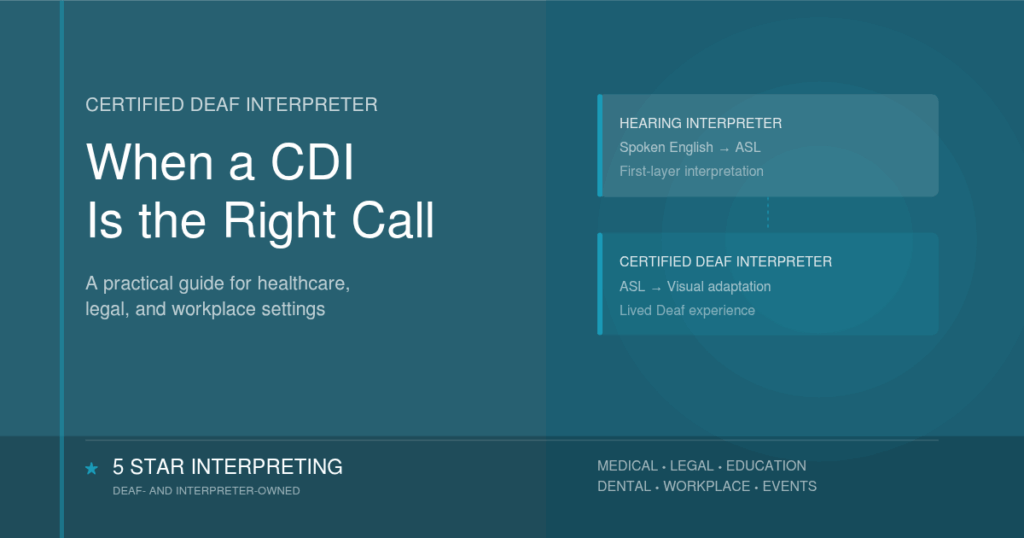
Most people who work with interpreting services have encountered a qualified ASL interpreter. Far fewer have worked with a Certified Deaf Interpreter. Even fewer understand when one is necessary. A CDI is a Deaf professional with advanced training in interpretation and communication mediation. They are specifically trained to work in partnership with hearing interpreters, not independently of them. That distinction matters. A CDI is not a replacement. They are a second layer of expertise. What makes CDIs uniquely effective is the combination of professional training and lived experience within the Deaf community. They understand regional variation, non-standard signing, and visual communication strategies that a hearing interpreter may not immediately recognize. Two individuals can both be Deaf and communicate in ways that look completely different. A CDI is trained to navigate that difference accurately.
How the Team Model Works
Understanding when a CDI is needed becomes much clearer when you look at how the interpreting team functions in practice.
| Step | Who | What happens |
|---|---|---|
| 1 | Hearing interpreter | Listens to spoken English and interprets into ASL |
| 2 | CDI | Receives the interpreted message and adapts it for the Deaf participant using the most appropriate visual communication method |
| 3 | Deaf participant | Responds in their preferred communication style |
| 4 | CDI | Interprets the response into standard ASL for the hearing interpreter |
| 5 | Hearing interpreter | Interprets the message into spoken English for hearing participants |
In practice, experienced teams move through this process fluidly. The Deaf participant does not experience it as a two-step relay. They experience it as a conversation that actually makes sense. Team interpreting also reduces cognitive fatigue on individual interpreters during long or complex assignments. Fatigue is one of the most consistent causes of interpreting errors, and it compounds quickly in high-stakes settings.
When a CDI Is the Right Call
Many organizations misjudge this. Not because they are careless, but because they do not know what to look for. The table below maps the situations where CDI support is not just helpful but often necessary.
| Situation | Why a CDI helps | Common settings |
|---|---|---|
| Deaf individual uses non-standard or regional signing | The CDI adapts the message visually and culturally, closing the gap a hearing interpreter cannot always bridge | Medical, legal, mental health |
| Limited formal language exposure | CDIs are trained to work with individuals who use home signs or have had minimal access to ASL education | Law enforcement, social services, and community programs |
| Emotionally intense or high-stakes conversation | The CDI brings cultural context and lived experience that support trust and precision when it matters most | Mental health counseling, legal proceedings, and crisis situations |
| Complex diagnosis or treatment decision | Medical information requires full understanding, not partial delivery | Hospitals, specialist consultations, and surgical consent |
| DeafBlind individual | CDIs can adapt to tactile communication methods not available to hearing interpreters | Any medical, legal, or community setting |
| Legal proceedings with significant consequences | Accuracy is legally material; a CDI adds a critical layer of verification | Court hearings, depositions, law enforcement interviews |
If there is any question about whether communication will be fully understood, that is usually your answer.
ADA Compliance and CDIs
The ADA requires effective communication, not simply the presence of an interpreter. That standard matters here more than most organizations realize. Providing an interpreter is step one. Ensuring the message is understood is the requirement. That distinction is where compliance is won, or lost. Courts have consistently held that covered entities must take communication barriers seriously and that the adequacy of support is measured by outcome, not intention. An organization that provides a hearing interpreter when a CDI is clearly needed has not met its ADA obligations simply because an interpreter was present. For a full breakdown of what the ADA requires across different settings, see 5 Star’s guide to ADA compliance for Deaf communication access.
Where CDIs Are Most Commonly Used
CDIs appear across a wide range of professional settings. Some come up more often than others.
- Legal proceedings, particularly when the Deaf individual is a party to the case, where accuracy is legally material
- Mental health counseling and crisis situations, where emotional nuance and trust are essential
- Medical consultations involving complex diagnoses, surgical consent, or treatment decisions
- Law enforcement interviews and investigative conversations
- Community services involving individuals with limited formal language exposure
- Educational settings with Deaf students who have non-standard communication needs
What these situations share is consequence. When misunderstanding carries real risk, whether to a patient’s health, a client’s legal rights, or a person’s safety, the standard of communication access has to match that weight.
What This Means for Organizations Planning Ahead
Most organizations that end up needing a CDI find out mid-appointment. That is the wrong time to make the decision. The better approach is to assess communication needs before the interaction begins. For scheduled appointments in healthcare, legal, or mental health settings, intake should include a question about the Deaf individual’s communication preferences and language background. That information allows the interpreting team to be properly structured before anyone walks through the door. As a Deaf- and interpreter-owned agency, 5 Star Interpreting builds this assessment into every placement. When a request comes in, the team evaluates whether a standard interpreter, a CDI, or a full interpreting team is the right fit, not just the most available option. The goal is not to staff every appointment the same way. It is to staff every appointment correctly, before it begins. For a broader look at how 5 Star approaches placement decisions, see the guide on on-site vs. remote interpreting and the overview of the role of a primary ASL interpreter.
The Right Team for the Conversation
A CDI is not a premium add-on. In the right situations, it is what effective communication actually requires. A hearing interpreter bridges spoken English and ASL. A CDI bridges standard ASL and the individual in the room. Together, they close a gap that one interpreter alone cannot always close.
Completely. Not partially. That is the standard.
Organizations that understand this do not just meet compliance requirements. They create communication that works, every time. 5 Star Interpreting serves Utah, Idaho, Illinois, and Georgia with Certified Deaf Interpreters available now.
FREQUENTLY ASKED QUESTIONS
A Certified Deaf Interpreter (CDI) is a Deaf professional with advanced training in interpretation and communication mediation. CDIs work alongside hearing interpreters. They receive the interpreted message from the hearing interpreter and adapt it to ensure the Deaf participant fully understands, using ASL, modified signing, gestures, or other visual communication methods as needed.
A CDI is typically required when the Deaf individual uses non-standard or regional signing, has had limited formal language exposure, is DeafBlind, or when the conversation is high-stakes enough that standard interpretation may not ensure full understanding. Common settings include legal proceedings, mental health counseling, medical consultations involving significant decisions, and law enforcement interviews.
The hearing interpreter listens to spoken English and interprets it into ASL for the CDI. The CDI then adapts the message for the Deaf participant using the most appropriate visual communication method. When the Deaf participant responds, the CDI interprets into standard ASL for the hearing interpreter, who voices it for hearing participants.
A qualified ASL interpreter is typically a hearing professional trained to interpret between spoken English and ASL. A CDI is a Deaf professional who works alongside the hearing interpreter to adapt the message for individuals with unique communication needs. CDIs bring lived Deaf experience, cultural fluency, and the ability to work with a wider range of communication styles that a hearing interpreter may not be trained to recognize.
HAVE QUESTIONS OR READY TO BOOK?
We’re here to help you find the right interpreter for your situation.