
Professional ASL Interpreters vs Volunteers
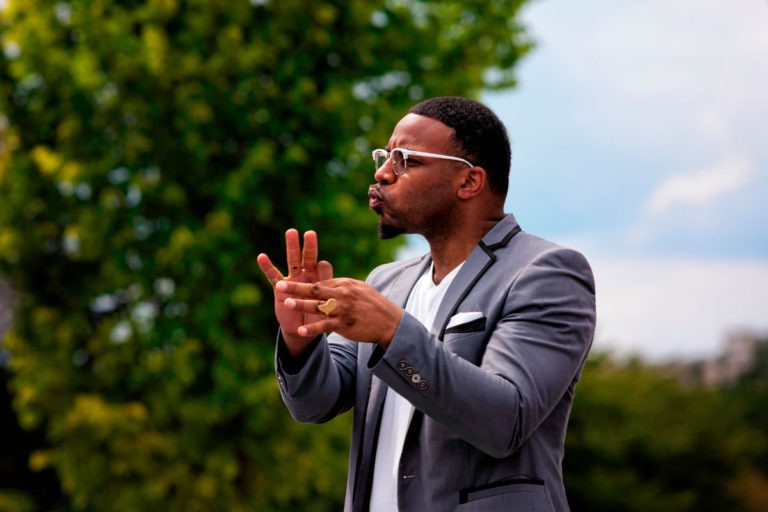
Many organizations ask a version of the same question: do we really need a professional ASL interpreters, or can we use someone who knows some sign?
The answer matters more than most people expect.
Good intentions do not guarantee accurate communication. And in healthcare, legal, and workplace settings, inaccurate communication carries real consequences — for the Deaf individual and for the organization.
Quick Answer
A professional ASL interpreter has formal training, adheres to a strict code of ethics, and is held to the ADA standard for effective communication. A volunteer, regardless of skill level or intent, typically cannot meet that standard in professional settings. Using an unqualified interpreter in healthcare, legal, or HR contexts creates compliance risk and puts the Deaf individual at a disadvantage.
What a Professional Interpreter Actually Does
The gap between someone who knows sign language and someone who interprets professionally is larger than most hearing people realize.
A professional ASL interpreter is trained to manage communication at speed, under pressure, across complex subject matter. They carry meaning, tone, and intent — not just words. They handle medical terminology, legal language, and emotionally charged conversations without filtering, softening, or omitting anything. They stay neutral even when the content is difficult.
That combination of skills comes from years of formal training, supervised practice, certification testing, and ongoing professional development. It is not something someone acquires by growing up around Deaf family members or taking a few ASL classes.
ASL is not signed English. It is a full, independent language with its own grammar, structure, and cultural norms. Effective interpretation requires fluency in both languages and the trained ability to move between them in real time.
Professional ASL Interpreters vs. Volunteer: The Full Comparison
The differences show up across every dimension of the work. This table covers the categories that matter most for organizations making this decision.
| Professional ASL Interpreter | Volunteer | |
|---|---|---|
| Training | Formal interpreter training programs, degree programs, & supervised practice | May know basic signs, rarely has formal training |
| Certification | RID, BEI, or state-level credentials with ongoing education requirements | No credentials required, no continuing education standard |
| Code of ethics | Strict professional ethics: neutrality, confidentiality, no advocacy | No ethical framework — filters, softens, or omits based on personal judgment |
| Accuracy | Handles speed, technical vocabulary, and complex concepts completely | May miss details, simplify concepts, or sign only parts of the message |
| Cultural fluency | Understands ASL as a full language with its own grammar, culture, and norms | May treat ASL as signed English — losing meaning and context |
| ADA compliance | Typically satisfies the ADA standard of effective communication | Rarely satisfies the ADA standard — creates legal exposure for the organization |
| Appropriate for | All professional settings: medical, legal, educational, workplace, events | True emergencies only, as a last resort until a professional is available |
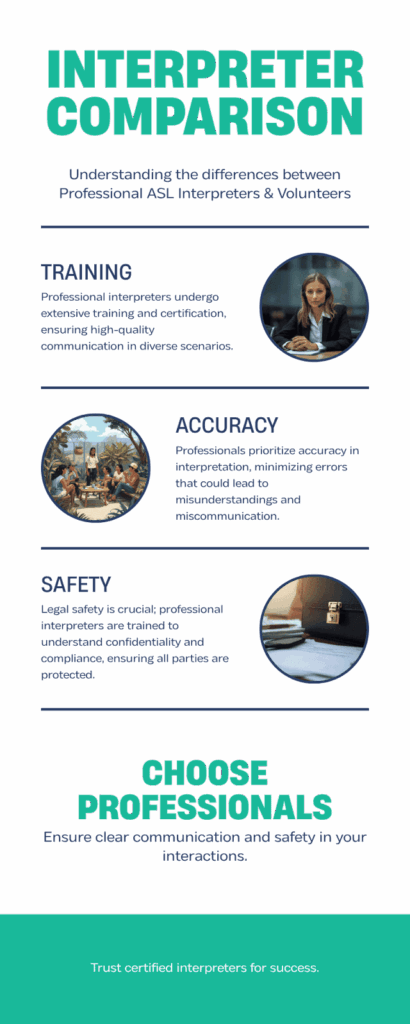
1. Training and Certification
Professional interpreters:
- Complete formal training programs
- Pass certification exams (such as RID, BEI, or state-level tests)
- Follow a professional code of ethics
- Maintain skills with ongoing education
Volunteers:
- May or may not know basic signs or have informal experience
- Often have no formal training or credentials
- May not understand interpreter ethics or boundaries
2. Accuracy and Information Volume
In high-stakes settings, the amount of information is large and complex:
- Medical details
- Legal language
- Policy explanations
- Safety instructions
Professional interpreters can:
- Keep up with the speaker
- Convey full sentences and complete ideas
- Handle technical vocabulary
Volunteers may:
- Miss key details
- Sign only parts of the message
- Confuse or simplify concepts
Even small gaps can lead to big misunderstandings.
3. Cultural and Ethical Understanding
ASL is not “signed English.” It is a full, rich language with:
- Its own grammar
- Its own culture
- Its own norms
Professional interpreters are trained to:
- Respect Deaf culture
- Avoid adding or hiding information
- Stay neutral, even when topics are emotional
Volunteers may:
- Filter or “soften” bad news
- Leave out embarrassing or complex information
- Feel uncomfortable interpreting sensitive topics
What Happens When the Wrong Choice is Made?
In 2017, a video of a volunteer ASL interpreter during a Hurricane Irma press conference in Florida went viral. The interpreter was well-intentioned. He was also signing nonsense, not accurately conveying emergency evacuation instructions to thousands of Deaf viewers who needed that information to make life-safety decisions.
Compare that to footage of a professional interpreter from a different Irma press conference the same week. The contrast is immediate and striking. One delivers complete, accurate information. The other creates confusion in a moment when confusion is dangerous.
In everyday interactions, an untrained interpreter’s mistakes may go unnoticed. In high-stakes settings, those mistakes show up in outcomes.
In emergencies, miscommunication is not an inconvenience. It is a safety risk.
The same principle applies in a hospital exam room, a courtroom, an IEP meeting, or an HR disciplinary conversation. The setting changes. The standard does not.
The Three Ways Volunteers Fall Short
1. Accuracy and Information Volume
Professional settings involve a high volume of complex, fast-moving information. Medical consultations cover diagnoses, treatment options, medication risks, and follow-up instructions. Legal proceedings involve terminology with precise legal meanings. Workplace training covers safety procedures that employees are expected to follow.
A professional interpreter keeps pace with the speaker, conveys complete sentences and full ideas, and handles technical vocabulary accurately. A volunteer typically catches fragments, simplifies concepts, and fills gaps with approximations. Even small gaps in medical or legal information can create significant misunderstandings.
2. Cultural and Ethical Understanding
Volunteers often interpret ASL as if it were signed English, mapping English words to signs without preserving the grammar and structure that give ASL its meaning. Information gets lost not because words are missed but because the linguistic framework is wrong.
Volunteers also tend to make editorial decisions, softening bad news, omitting uncomfortable details, or filtering sensitive information because they feel protective of the Deaf person or are uncertain how to handle the content. A professional interpreter does not make those decisions. Their job is to convey everything, accurately and impartially.
Confidentiality cannot be guaranteed. And the Deaf individual may hold back information they would share with a neutral professional.
3. Neutrality and Professional Boundaries
A professional interpreter does not take sides, offer opinions, or advocate for either party. They cannot act as an assistant or decision-maker. That neutrality is part of what makes the communication trustworthy for everyone in the room.
Volunteers, particularly family members, often struggle with this boundary. Emotional involvement affects accuracy in ways the volunteer may not even recognize.
When a Volunteer is Ever Acceptable
There is one narrow situation where a volunteer interpreter may be appropriate: a genuine emergency where no professional is available and basic, immediate information needs to be communicated right now.
Even then, it is a temporary measure — not a solution.
For any planned interaction — a medical appointment, a legal meeting, a workplace training, a school conference, a community event — a volunteer is not appropriate. The stakes are too high, the information too complex, and the legal obligations too clear.
For a full breakdown of what the ADA requires in these settings, see the guide to ADA compliance for Deaf communication access.
How Someone Becomes a Professional ASL Interpreter
Professional interpreting is not a skill people pick up casually. The path involves formal ASL and interpreter training programs, often at the degree level. It involves hundreds of hours of supervised practice in real interpreting environments. It involves passing certification exams that measure both language skills and professional ethics. It involves ongoing education to maintain credentials and stay current with evolving language norms.
Specialization takes that further. Medical interpreters develop familiarity with clinical terminology and patient care environments. Legal interpreters understand courtroom procedure and the precise language of law. Mental health interpreters are trained to handle emotionally intense communication without disrupting therapeutic relationships.
The right interpreter for the assignment is not just someone who is certified. It is someone who is certified and experienced in the specific setting and subject matter required by the conversation.
For more on what qualifications to look for and when a Certified Deaf Interpreter is needed alongside a primary interpreter, see the guide to when to use a Certified Deaf Interpreter.
The ADA: What the Law Actually Requires
Under the Americans with Disabilities Act, organizations must provide effective communication for Deaf and hard-of-hearing individuals. For complex interactions in healthcare, legal, and workplace settings, that standard typically means providing a qualified ASL interpreter.
Using an unqualified interpreter does not satisfy the ADA standard. It creates compliance risk.
Failing to provide appropriate communication access can result in ADA complaints, civil rights investigations, lawsuits, and significant reputational damage, particularly within the Deaf community, which is close-knit and communicates quickly about which organizations treat Deaf individuals with respect and which do not.
The cost of a professional interpreter is small compared to the cost of a complaint, a lawsuit, or the loss of trust from a community that relies heavily on word-of-mouth referrals.
There may also be tax credits available to help offset the cost of accessibility accommodations. Consult a tax professional for details specific to your organization.
What the Right Choice Builds
Organizations that consistently use professional ASL interpreters are not just avoiding risk. They are building something.
The Deaf community notices. When an organization treats access to communication as a genuine priority, not an afterthought, that reputation travels. Deaf individuals refer others to providers and employers who have treated them well. They return. They trust.
When an organization relies on volunteers, family members, or improvised solutions, that reputation travels too.
Professional interpreting is not just compliance. It is how you demonstrate that Deaf individuals are fully welcome in your space.
For a deeper look at how this plays out in specific settings, see the guide to the role of a primary ASL interpreter.
Good Intentions Are Not Enough
A volunteer who knows some sign is doing their best. That is worth acknowledging. It is not, however, a substitute for qualified professional interpreting when the situation requires it.
Communication must be accurate. Completely, not approximately.
In the settings where it matters most, the difference between a professional interpreter and a well-meaning volunteer is evident in what the Deaf individual understands, the decisions they can make, and whether the organization has met its legal and ethical obligations.