
Role of a Primary ASL Interpreter: Turning Access Into Understanding

Hiring an interpreter does not automatically resolve communication problems. It does not close language access gaps on its own. And in regulated industries, especially, it does not guarantee understanding.
Understanding is the goal. Hiring is step one.
The role of a primary ASL interpreter is to bridge that gap, ensuring every person in the conversation receives accurate, complete, equitable access to the information being exchanged.
Quick Answer
A primary ASL interpreter leads real-time interpretation between spoken English and ASL, manages the flow of communication, and coordinates with a Certified Deaf Interpreter (CDI) when needed. They are responsible for accuracy, tone, and cultural nuance, and for ensuring that nothing of substance is lost in the exchange. In healthcare, legal, and education settings, that standard is not optional.
Defining the Role of a Primary ASL Interpreter
ASL interpreting provides real-time communication support for Deaf and hard-of-hearing individuals by interpreting between spoken English and American Sign Language. The primary interpreter leads that work. In team interpreting situations, they manage the assignment, set the pace, and coordinate with a CDI if additional language support is needed.
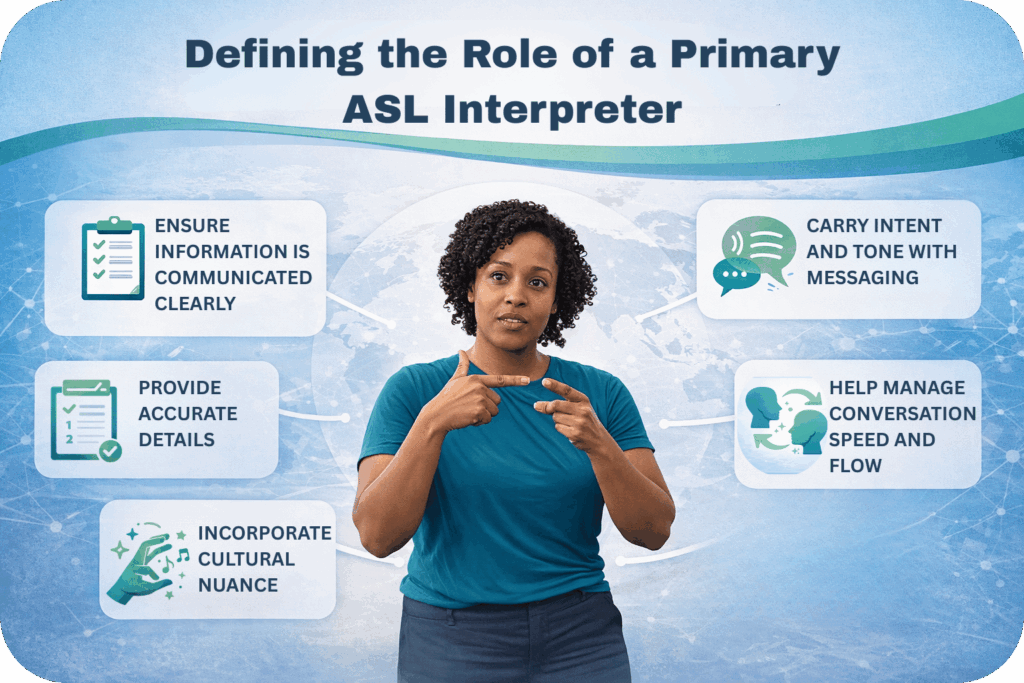
On any given assignment, a primary interpreter is responsible for:
- Communicating information clearly and completely, without summarizing or approximating
- Carrying intent and tone, not just words
- Conveying full, accurate details, including names, numbers, timelines, and instructions
- Incorporating cultural nuance so the message makes sense in ASL without losing context
- Managing communication flow in fast-moving or multi-speaker situations without losing accuracy
The difference between a strong interpreter and an adequate one often shows up under pressure, in a fast-moving medical consultation, a tense HR meeting, or a complex legal deposition where every word carries weight.
Where Primary Interpreters Work
Primary interpreters work anywhere where ASL interpreting services and communication access are needed. What those settings share is consequence; incomplete access creates real problems, not minor inconveniences.
| Setting | What a primary interpreter handles |
|---|---|
| Healthcare | Doctor visits, intake and discharge, specialist consultations, mental health sessions, patient education, and follow-up instructions |
| Legal | Attorney-client meetings, depositions, hearings, mediation sessions, and court proceedings |
| Education | K-12 classrooms, IEP and 504 meetings, parent-teacher conferences, tutoring, counseling, and campus events |
| Workplace | Job interviews, HR conversations, team meetings, corporate training, and presentations |
| Government and community | Public meetings, civic proceedings, community programs, and local agency communication |
For a full overview of service types and settings, see 5 Star’s interpreting services.
A Certified Interpreter VS. Someone Who Can Sign
In everyday moments, having the support of a friend, family member, or volunteer who can sign can be extremely helpful. In professional settings, that is not the same as a certified interpreter.
Certified interpreters protect rights. Signers relay words. Those are different functions.
A primary ASL interpreter:
- Has specialized training in interpretation, not just ASL fluency
- Follows a strict professional code of ethics
- Maintains confidentiality on every assignment
- Stays neutral and does not offer opinions, take sides, or provide advice
- Cannot act as an assistant, advocate, or decision-maker for either party
That professional boundary is what makes interpreting reliable under pressure. For a fuller look at why the distinction matters in practice, see professional ASL interpreters vs. volunteers.
ASL Interpreting Qualifications and Certification
Certification is one indicator of a qualified interpreter. It is not the only one.
The Registry of Interpreters for the Deaf (RID is the most recognized national credential, but setting-specific experience often carries just as much weight. Medical, legal, education, workplace, and conference interpreting each requires different pacing, terminology, and communication management. An interpreter who excels in a classroom may not be the right fit for a deposition. One who handles legal proceedings fluently may struggle with the pace and emotional complexity of a mental health session.
The right interpreter for the assignment is the one with the right combination of certification, setting experience, and subject matter familiarity, not just whoever is available.
When a Primary Interpreter Works With a CDI
Some assignments require more than a single interpreter. When they do, the primary interpreter works alongside a Certified Deaf Interpreter (CDI).
A CDI is a Deaf professional who adapts the message for individuals with unique language needs — non-standard signing, limited formal language exposure, regional dialects, or communication backgrounds that a hearing interpreter may not fully navigate alone.
CDI support is typically needed when:
- The Deaf individual uses non-standard or regional ASL
- There is limited formal language exposure or language deprivation
- The conversation involves mental health, trauma, or crisis communication
- Legal accuracy is critical, and any misinterpretation carries real consequences
- The individual is DeafBlind and requires tactile communication
In legal and medical settings especially, a CDI is not an add-on. It is the appropriate standard of care when the situation calls for it.
For the full breakdown of when and why CDI support is needed, see the guide to when to use a Certified Deaf Interpreter.
Why This Role Matters: What is at Stake
Understanding shapes outcomes. That is true across every setting where a primary interpreter works. What the consequences look like depends on where you are.
Healthcare: Patient Safety Depends on Clarity
In medical settings, incomplete communication is not an inconvenience. It can lead to medication errors, missed diagnoses, incomplete medical histories, or poor adherence to treatment plans. A patient who does not fully understand their diagnosis cannot make a fully informed decision about their care. The format of coverage affects this, too. For complex diagnostic and treatment conversations, the physical presence of an interpreter often makes the difference. See the guide to on-site vs. remote interpreting for a full breakdown of when each format is appropriate.
A primary ASL interpreter ensures providers and patients are genuinely aligned, not approximately understood. See medical ASL interpreting services for more.
Education: Access Supports Learning and Family Involvement
In schools, an interpreter is not a one-time accommodation. They are a daily presence that determines whether a student can follow instruction, participate in discussion, and access the full experience of being in a classroom. When families have complete access to information, collaboration improves, and students benefit.
Interpreting makes a difference in classrooms, IEP and 504 meetings, parent-teacher conferences, counseling, and campus activities. The impact goes well beyond the classroom walls.
See the full guide to ASL interpreting in education for a deeper look at what consistent access changes
Legal Settings: Accuracy Protects Due Process
Legal conversations leave almost no room for error. In depositions, hearings, mediation, and attorney-client meetings, accuracy and neutrality are the minimum standard. A primary interpreter protects due process by ensuring the message is conveyed completely and faithfully, without omission or personal influence.
See legal interpreting services for more
Workplace: Inclusion Improves Performance and Safety
Communication in the workplace affects everything from safety compliance to career growth. An employee who cannot fully participate in training, HR conversations, or team meetings is operating at a consistent disadvantage. Consistent access supports better collaboration, clearer safety expectations, and more equitable professional development.
See workplace interpreting services for more.
ADA Compliance: Equal Access Is a Requirement
The Americans with Disabilities Act (ADA) requires effective communication for individuals who are Deaf, hard of hearing, or DeafBlind. In many situations, providing a qualified interpreter is part of meeting that obligation. A primary ASL interpreter helps organizations ensure communication is effective, consistent, and appropriate for the setting.
Providing an interpreter is step one. Ensuring communication is effective is the requirement.
For a full breakdown of what the ADA requires across settings, see the guide to ADA compliance for Deaf communication access.
Access into Understanding
A primary ASL interpreter does not just relay language. They carry the full weight of a conversation across a communication barrier in real time, under pressure, without losing accuracy or nuance.
When they do that well, people can make informed decisions.
Participate fully. Be understood completely.
That is what the role is for. And in the settings where it matters most, the difference between getting it right and getting it approximately right shows up directly in outcomes.
Ready to Book a Qualified ASL Interpreter?
5 Star Interpreting coordinates primary interpreters and CDI teams for healthcare, legal, education, workplace, and event settings across Utah, Idaho, Illinois, and Georgia.